
Maturing Commercial Loans in 2026: Managing Commercial Loan Maturity Risk in a $936 Billion Wall
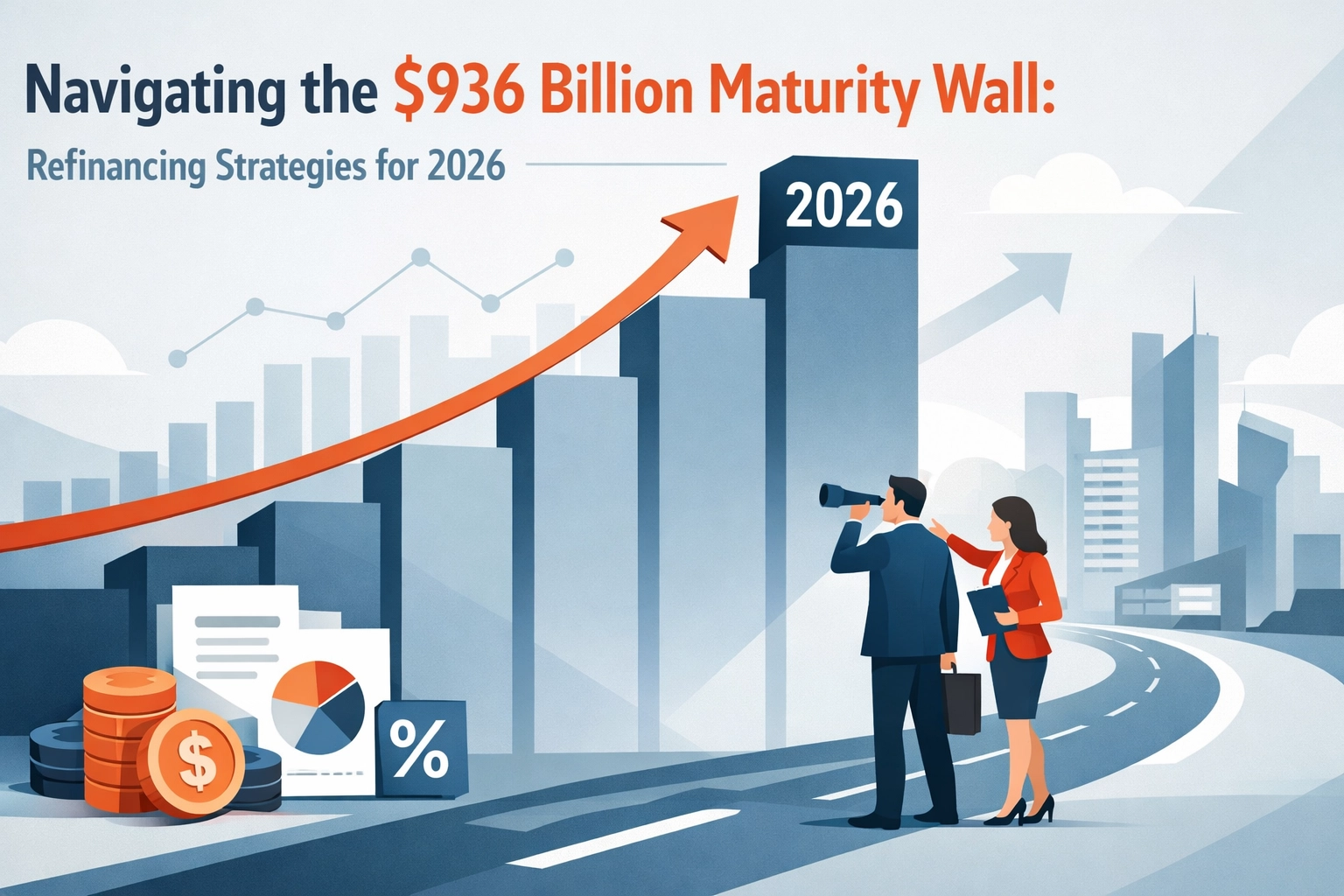
$936 billion in maturing commercial loans hit in 2026.
A concentrated refinancing cycle. A real capital markets test. A direct commercial loan maturity risk event.
This is not theoretical.
- Debt at risk
- Equity at risk
- Exit pricing at risk
If you are asking what happens when a commercial loan matures, the answer is simple.
- The note comes due
- The balloon payment commercial loan balance is payable
- If you cannot pay it off or refinance, you are negotiating from a weak position
Wait until Q3 or Q4 and you are competing for attention in the most congested part of the commercial real estate capital markets calendar. Move early and you control options when a commercial loan matures.

The Maturity Wall Was Built on Borrowed Time (Extend-and-Pretend Included)
The 2026 maturity cliff did not appear overnight.
In 2025, lenders and borrowers leaned on deferrals, amendments, and maturity extensions to push risk into 2026. Call it what you want.
- Extend and amend
- Extend and pretend commercial loans
- Temporary forbearance with new covenants
The objective was consistent: buy time for pricing to recover and for interest rates and commercial real estate to settle into a new range.
As of Feb 2026, the market has more clarity. Not more forgiveness.
Loans originated in 2021 and 2022 at 3% floating rates are now refinancing into materially higher coupons. Valuations and leverage tolerance have reset. Lenders that already granted one extension are typically demanding more:
- Paydowns
- Cash management
- Reserves
- Stronger reporting
- Tighter DSCR
The maturity wall reflects postponement, not resolution. That is the definition of commercial loan maturity risk.
Market Conditions in Feb 2026: Demanding, Not Forgiving
Refinancing in 2026 is not a rerun of 2021. The operating environment is tighter across rate, leverage, and execution.
Interest Rate Environment
The Federal Reserve has shifted tone, but the practical outcome is this: borrowing costs remain high versus the 2020–2022 window. Loans that used to clear at 300 bps over SOFR are frequently clearing wider, depending on sponsorship and asset risk.
For borrowers staring at maturing commercial loans, this is the core issue. Higher debt service reduces proceeds. Lower proceeds trigger paydowns. Paydowns trigger equity decisions.
Rate compression alone is not arriving fast enough to erase commercial loan maturity risk across the market.
Property Valuations
Valuations remain under pressure in specific sectors. Leverage is tighter. Appraisals are more conservative.
If you are trying to refinance maturing commercial loan balances at peak-era proceeds, you are likely solving for one of these:
- New equity
- Partial paydown
- Preferred equity / mezzanine
- Short-term bridge with a clear takeout plan
Properties that cash flow refinance. Properties that do not move into commercial loan workout conversations.
Underwriting Standards
Underwriting tightened through 2024 and 2025 and remains tight in Feb 2026.
- Higher DSCR targets
- Lower LTV caps
- Stronger sponsor liquidity requirements
- More reserves (TI/LC, capex, insurance)
The days of accommodative terms are over.

Competitive Pressure for Capital
The calendar is underwriting.
Early 2026 activity is manageable. By mid-year, lender bandwidth gets consumed by the maturity wall. Lenders prioritize:
- Clean stories
- Current financials
- Third-party readiness
- Straight execution
Complicated deals still get done. They just cost more time, more structure, and more concessions.
Strategic Framework: Options When a Commercial Loan Matures (2026 Playbook)
Borrowers who execute in 2026 follow a disciplined approach built around one question: what happens when a commercial loan matures on your specific asset and timeline.
The execution path depends on cash flow, valuation, sponsor liquidity, and lender posture. The strategy is not generic. It is structured.
Act in Q1 or Q2: Not Q4
The refinancing calendar is not linear.
Early movers secure lender attention, better structure, and cleaner execution. Late movers compete in the most crowded part of the year.
Operational reality:
- Most lenders need 60–90+ days for underwriting, third-party reports, legal, and closing
- Year-end slows everything down
- If you start in October, you can create January problems
For maturing commercial loans, time is a pricing variable. Start early.
Validate Underlying Asset Performance (Before You Refinance)
This is not the time for optimistic underwriting.
Lenders in Feb 2026 are underwriting to what is real:
- In-place NOI
- Rent roll and lease expirations
- Tenant quality
- Insurance and tax trends
- Capex history and upcoming needs
Stable cash flow refinances. Weak cash flow triggers either a lower leverage outcome or a more complex capital stack.
Run conservative models. Assume rates stay elevated. Stress DSCR. This is basic commercial real estate risk management for refinancing a maturity.
Commercial Refinance Options: Banks, CMBS, Agency, Life Co, Private Credit
One bank is not a capital strategy.
In 2026, commercial refinance options matter because lender appetite is fragmented by property type, geography, and sponsor strength.
Common capital sources:
- Agency debt (Fannie Mae, Freddie Mac) for stabilized multifamily
- Regional and community banks for relationship-driven deals
- CMBS conduits for larger, institutional-quality assets
- Life companies for long-term fixed-rate, core assets
- Private credit for speed, flexibility, transitional business plans, or non-conforming situations
Private credit is also the lane for a bridge loan for maturing debt when the asset is not ready for permanent takeout today.
Working with a broker expands the lender set and improves execution leverage in a crowded market.

Balloon Payment Commercial Loan Reality: Paydowns, Equity, and Resets
Many borrowers are relearning how balloon structures behave in a higher-rate cycle.
A balloon payment commercial loan coming due is a binary event. You either:
- Pay it off (sale or cash)
- Refinance it
- Negotiate an extension/workout
Lower valuations and tighter underwriting mean many borrowers must solve for new equity or paydowns to refinance.
Common structural outcomes in Feb 2026:
- Lower proceeds due to DSCR constraints
- Higher pricing and tighter covenants
- Additional reserves and cash management
- Recourse or partial recourse in weaker stories
- Shorter terms with extension tests
These are not “gotchas.” They reflect capital markets discipline.
Work With a Specialist: Refinance Maturing CRE Loan Execution
The maturity wall creates information asymmetry. Borrowers with real pricing intel and multiple lender options get better outcomes.
A broker-driven process is designed to:
- Source competing term sheets across lender types
- Match asset profile to lender credit box (today, not last year)
- Structure around DSCR, LTV, and timing constraints
- Manage third parties and closing to hit the maturity date
If you need to refinance maturing CRE loan exposure in 2026, execution speed and lender access are not optional.
Commercial Real Estate Debt Strategies in Feb 2026: What Lenders Are Doing
While borrowers manage refinancing pressure, lenders are managing risk, regulators, and portfolio concentration.
Current lender dynamics:
- Banks are selective and watching CRE concentration limits closely
- CMBS is active for the right assets, with sharper underwriting and structure
- Life companies remain conservative and favor core assets
- Private credit continues to fill gaps, pricing the risk accordingly
Private credit is not “bad debt.” It is a tool. It can be the right answer for a transitional plan, a near-term maturity, or a complex sponsorship story. It can also be expensive if it is used without a takeout path.
For a broader view of the CRE debt landscape and maturity volumes, review Trepp’s research:
- Trepp report (PDF): https://www.trepp.com/hubfs/Trepp%20Inside%20the%20$4.8T%20CRE%20Debt%20Universe%20Report.pdf
For market research and ongoing data on commercial/multifamily finance, MBA is a strong reference point:
- Mortgage Bankers Association (MBA) research: https://www.mba.org/news-and-research/research-and-economics/commercial-multifamily-research
The Window Is Narrowing
By the time most borrowers recognize the urgency of the maturity wall, the best execution windows will have closed.
In Feb 2026, the market is open. It is just not patient.
If you are facing maturing commercial loans, the “end game” is clear:
- Pay off at maturity
- Sell before maturity
- Refinance maturing commercial loan
- Use a bridge loan for maturing debt with a defined takeout
- Negotiate extension terms (often “extend and pretend” with new covenants)
- Enter a commercial loan workout / commercial loan restructuring if performance cannot support a refinance
This is where commercial real estate debt strategies and commercial real estate risk management intersect with execution. Your outcome is a function of timing, documentation quality, and lender access.
Triton Equity Group, LLC provides access to thousands of loan products from hundreds of lenders on one platform, combined with concierge execution. For borrowers searching for a commercial loan broker Florida, we run lender coverage across Florida and nationally to source the best-fit structure for the asset and the maturity date.
Learn more at https://michaelvaldes.commloan.com.
The maturity wall is here. The time to act is now.




Continue Reading



Have a Deal in Progress?
Let’s structure the right capital solution.
