
Refinancing the "Tough" Deals in 2026: Office and Retail Strategies That Still Get Done

Office and retail properties are carrying the heaviest underwriting burden in commercial real estate right now.
Over $1.5 trillion in CRE loans mature through 2026 (see the Mortgage Bankers Association coverage of the CRE “maturity wall”), and lenders are stress-testing office and retail assets harder than any other property type. Debt Service Coverage Ratio thresholds are tighter. Leverage is lower. Extensions are expensive or unavailable.
But deals are still getting done.
The difference between properties that refinance successfully and those that don't comes down to metrics, structure, and capital source selection. This is the practical playbook for office and retail owners navigating the toughest refinancing environment in a decade.
Why Office and Retail Face the Toughest Scrutiny
Lenders view office and retail as higher-risk categories in 2026 for clear reasons.
Office properties face structural headwinds from remote work adoption, tenant downsizing, and building obsolescence. Class B and C assets in secondary markets are particularly vulnerable. Properties without recent capital improvements, ESG upgrades, or flexible floor plans struggle to attract lender interest.
Retail properties contend with e-commerce pressure, anchor tenant bankruptcies, and traffic concerns. Strip centers and single-tenant assets tied to struggling categories (apparel, department stores) face the harshest treatment.
Lenders now stress-test both property types on occupancy volatility, tenant creditworthiness, and operational resilience. Properties that looked financeable three years ago may no longer clear current underwriting standards without structural adjustments.

The Metrics That Matter Now
Lenders in 2026 are drilling into four critical data points before committing capital to office and retail refinances. For current market cap rate benchmarks, reference the latest CBRE U.S. Cap Rate Survey (H2 2024).
Tenant Quality and Credit Strength
Who occupies your building matters more than ever.
Properties anchored by investment-grade tenants (S&P rated BBB- or higher) get preferential treatment across all capital sources. Lenders view credit tenants as income stabilizers, particularly in volatile asset classes.
National chains, government tenants, healthcare providers, and essential service retailers carry the most weight. Local mom-and-pop tenants or startups without established credit profiles trigger higher risk premiums or reduced proceeds.
Document tenant financials thoroughly. Lenders want proof of rent payment history, sales performance (for retail), and renewal probability.
Weighted Average Lease Term (WALT)
WALT measures the average remaining lease duration across all tenants, weighted by square footage.
Office and retail properties with WALT above 5 years refinance more easily. Assets with WALT below 3 years face skepticism because lenders see imminent rollover risk and potential income disruption.
If your WALT is short, focus on lease renewals and extensions before approaching lenders. A 3-year lease extension with a major tenant can fundamentally change your refinancing options.
Lease Rollover Schedule
Lenders analyze your rollover schedule to assess re-leasing risk.
Properties with more than 30% of NMI expiring in the next 24 months trigger conservative underwriting. Lenders stress-test those rollovers at higher vacancy assumptions and longer re-tenanting periods.
If you have concentrated rollover risk, address it preemptively:
- Negotiate early renewals with flexible terms
- Document tenant retention conversations
- Prepare marketing plans for vacant space
- Show recent comparable lease transactions demonstrating market rent support
Rent Comparables and Market Positioning
Lenders scrutinize whether your in-place rents are above, at, or below market.
Properties with rents 10%+ below market get penalized because lenders assume tenants will relocate at expiration. Properties with rents significantly above market face the opposite concern: retention risk when leases expire.
Provide third-party rent comp studies from reputable brokers. Show your property's competitive positioning on location, access, parking, amenities, and condition. Demonstrate why tenants renew despite comparable options.

How to Structure Deals That Actually Close
Creative deal structure separates closeable refinances from dead ends in 2026.
Lower Leverage Expectations
Office properties that previously financed at 70-75% LTV now max out at 60-65% for conventional lenders. Retail fares slightly better at 65-70% depending on tenant mix.
If you need higher leverage, prepare to bring additional equity, accept mezzanine debt at higher cost, or pursue alternative structures.
A/B Note and Preferred Equity Structures
Split your capital stack to access higher proceeds.
An A/B note structure places senior debt with a conservative lender (bank, life company, agency) at lower leverage, then layers subordinated B-note debt from a debt fund or credit investor at higher rates.
Preferred equity sits behind all debt but ahead of common equity. It carries equity-like returns (12-18%) but provides the property sponsor with more control than mezzanine debt.
These structures let you hit target leverage while giving conservative lenders the senior position they require.
Partial Paydown Strategy
If your existing loan balance exceeds what lenders will refinance, consider a partial paydown to right-size leverage.
Inject equity or monetize other assets to reduce the loan balance before refinancing. This approach preserves favorable terms on the new loan and avoids expensive mezzanine debt.
Some sponsors execute cash-out refinances on stronger properties to fund paydowns on weaker office or retail assets. This portfolio-level strategy optimizes overall capital structure.
Credit Tenant Lease (CTL) Financing
Properties with strong credit tenants can access CTL financing, which underwrites primarily on tenant creditworthiness rather than property fundamentals.
CTL loans often achieve 80-90% LTV because lenders view them as quasi-bond investments backed by investment-grade tenant leases. These loans work best for single-tenant net lease retail or office properties with long-term leases to rated tenants.
Alternative Capital Sources Beyond Traditional Banks
Multiple capital sources compete for office and retail refinances in 2026. Matching your asset to the right lender type dramatically improves execution probability.
CMBS Conduit Loans
CMBS lending is experiencing a 2026 comeback for deals above $5 million.
Conduit loans offer 5-10 year terms, 65-75% LTV, and non-recourse structure. They work well for stabilized retail and office properties with predictable cash flow, even if those properties don't meet agency or life company standards.
CMBS lenders underwrite to property cash flow and focus less on sponsor strength, making them accessible for transitional sponsors or properties with modest tenant credit.
Marcus & Millichap: 2026 U.S. Office Investment Forecast
Life Insurance Companies
Life companies remain active for institutional-quality office and retail with strong sponsorship.
They offer 10-year fixed rates, 60-65% LTV, and patient capital for properties that meet strict underwriting: Class A buildings, investment-grade tenants, primary markets, strong ESG compliance.
Life companies move slowly but provide stability and certainty for best-in-class assets.
Debt Funds and Private Credit
Private credit funds fill the gap for properties that don't fit conventional boxes.
These lenders offer bridge loans, value-add financing, and higher leverage (up to 75-80% LTV) at premium rates (8-12%+). They close faster than traditional sources and underwrite more flexibly on transitional properties, lease-up situations, or repositioning plays.
Debt funds work particularly well for office conversions, retail re-tenanting, or properties with near-term value creation plans that will improve future refinancing options.

Regional and Community Banks
Local banks maintain relationships with office and retail owners in their markets.
They offer competitive pricing, flexible terms, and faster decisions for deals under $10 million. Banks prioritize sponsor relationships and local market knowledge over purely quantitative underwriting.
Community banks often refinance properties that large national lenders reject, particularly in secondary and tertiary markets where local lenders understand nuances that distant underwriters miss.
SBA 504 Loans (Owner-Occupied)
Owner-occupied office and retail properties qualify for SBA 504 financing with favorable terms.
SBA loans provide up to 90% LTV, 25-year amortization, and below-market fixed rates. They require owner-occupancy of at least 51% of the building and qualifying small business operations.
This option works for professional office users (medical, dental, accounting, legal) and retail owner-operators. The program is underutilized but highly effective for qualifying borrowers.
Execution Best Practices for 2026 Refinances
Successful office and retail refinances in 2026 follow specific timing and preparation protocols.
Start 9-12 months before maturity. Waiting until your loan's open period arrives eliminates negotiating leverage and forces you into expensive extensions or distressed scenarios.
Clean up financials and documentation. Resolve liens, cure title issues, and organize three years of property financials, rent rolls, and lease files. Lenders reject incomplete packages without hesitation.
Model multiple scenarios. Test tradeoffs between loan types, leverage levels, amortization periods, and cash-out options. Understand your walkaway point before negotiations begin.
Time market conditions strategically. January through April offer the smoothest lender execution. Avoid November-December when holiday delays and year-end pipeline constraints create friction.
Improve NOI before approaching lenders. Reduce expenses, address deferred maintenance, and optimize operations to strengthen your underwriting case. Small NOI improvements compound into significantly better loan proceeds.
Engage experienced financing advisors. Office and retail refinances in 2026 require specialized knowledge of alternative capital sources and creative structuring. Brokers with deep lender relationships identify options that direct approaches miss.
The Properties Getting Financed
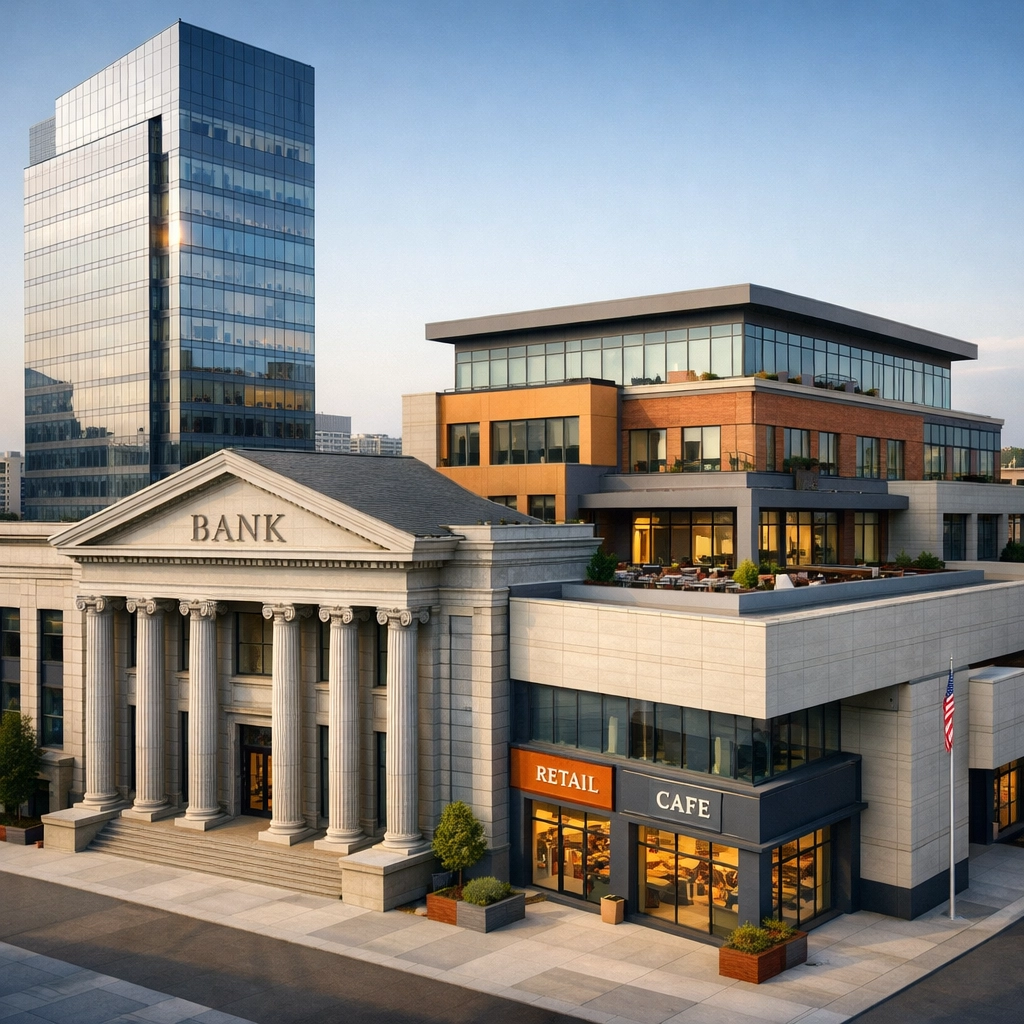
Despite tighter standards, specific office and retail profiles continue securing favorable refinancing terms in 2026.
Office properties with investment-grade tenant concentrations, recent building improvements, LEED certification, locations in urban cores or life science corridors, and WALT exceeding 7 years refinance at 60-65% LTV through life companies and CMBS.
Retail properties anchored by grocery, healthcare, discount retail, or quick-service restaurants in strong demographics refinance at 65-70% LTV through conduit lenders and regional banks.
Properties outside these profiles require creative structuring, alternative capital sources, or equity injections: but executable solutions exist for most situations.
Moving Forward
Office and retail refinancing in 2026 demands more preparation, flexibility, and capital source diversity than any recent period.
Properties with strong fundamentals, early planning, and experienced advisors continue refinancing successfully. Assets requiring structural adjustments or alternative capital can still execute with proper strategy.
The difference between deals that close and deals that don't comes down to understanding current underwriting standards, addressing lender concerns proactively, and matching properties with appropriate capital sources.
Triton Equity Group structures office and retail refinances across traditional and alternative capital sources. We assess your property's specific metrics, identify optimal lender matches, and execute financing solutions that work in today's market.
Contact Mike Valdes at Triton Equity Group, LLC to discuss your office or retail refinancing strategy.




Continue Reading



Have a Deal in Progress?
Let’s structure the right capital solution.
